
Callaway County Civil Docket Searches
Missouri Case.net is where a Callaway County civil docket search starts. The county runs no separate official civil database of its own. Case.net lets you look by name, case number, filing date, scheduled hearings, or judgments against a party. The interface guides each option. Pick the Callaway County or 13th Judicial Circuit selector when it appears. Then open the case number to reach the Case Header, Parties, and Docket Entries tabs. A known case number is always the fastest way in.
Read the case type before trusting a title. Civil, family, probate, small-claims, and municipal cases all live in the statewide system. Each follows its own schedule and access rules. One more distinction matters. The Callaway County Circuit Clerk, not the elected County Clerk, keeps the Circuit Court docket and file. Route requests for a civil record or certified copy to that office.
- Choose Case Number Search if a summons, notice, or prior court paper gives the number.
- For a name search, enter the displayed plaintiff, defendant, petitioner, or respondent and add a first name when useful.
- Compare the Callaway court, case type, filing date, party roles, and case style before opening the result.
- Read Docket Entries from the filing through the newest setting, order, judgment, or satisfaction entry.
- Use the Circuit Clerk or courthouse terminal for a public document that cannot be opened remotely.
Callaway County CV Case Numbers
Missouri builds case numbers from several parts. These include a two-digit year, a location identifier, a two-letter category, a five-digit sequence, and a subcase code. Civil cases carry CV. Municipal ordinance matters use MU. County ordinance cases use CY, and probate has its own PR category. Type the exact number from your court notice rather than a guessed example. The category narrows a search. But the case header and division still tell you what the case really is.
| Case.net option | When it helps | What to verify |
|---|---|---|
| Party name | The public party name is known | Role, case type, court, and filing date. |
| Case number | A court paper gives the complete identifier | That the result is in Callaway and has the correct category. |
| Filing date | The filing period is known but the number is not | Case style and court selection. |
| Judgment against | A public judgment search is appropriate | Judgment date, satisfaction, and case number. |
A Case.net result can stop at the docket entry with no document attached. An ECASE flag means the court keeps the file electronically. That does not guarantee remote access to every attachment. Some public material only opens at the local terminal.
Civil Dockets: What They Show
Think of a Callaway civil docket as the dated register of case activity. It is not the whole file. The case header lists the number, division, filing date, case type, style, judge, status, and parties. The Parties tab separates plaintiffs from defendants, petitioners from respondents, and flags intervenors or guardians. The entry list then tracks the life of the case. You will see the petition or complaint, service, answer, motions, notice of setting, hearing, order, judgment, post-judgment motions, execution, garnishment, satisfaction, and appeal.
| Case number and type | The court identifier and category, commonly CV for civil matters. |
|---|---|
| Party and attorney block | Publicly displayed roles and attorney information where the rules permit it. |
| Service and answer | Entries showing notice or response activity, not the merits of a claim. |
| Setting and order | Calendar placement and judicial action; a motion entry is not itself a ruling. |
| Judgment fields | Judgment date, amount or summary where displayed, satisfaction, execution, or appeal activity. |
When legal effect matters, read the signed order or judgment itself. An entry saying "motion filed" records only that a request was made. It does not mean the judge ruled. A judgment entry tells you more. But exact wording still comes from the official signed document or a certified copy. For court contacts, the Callaway County officials directory separates the county-government office listing from the court's Circuit Clerk function.
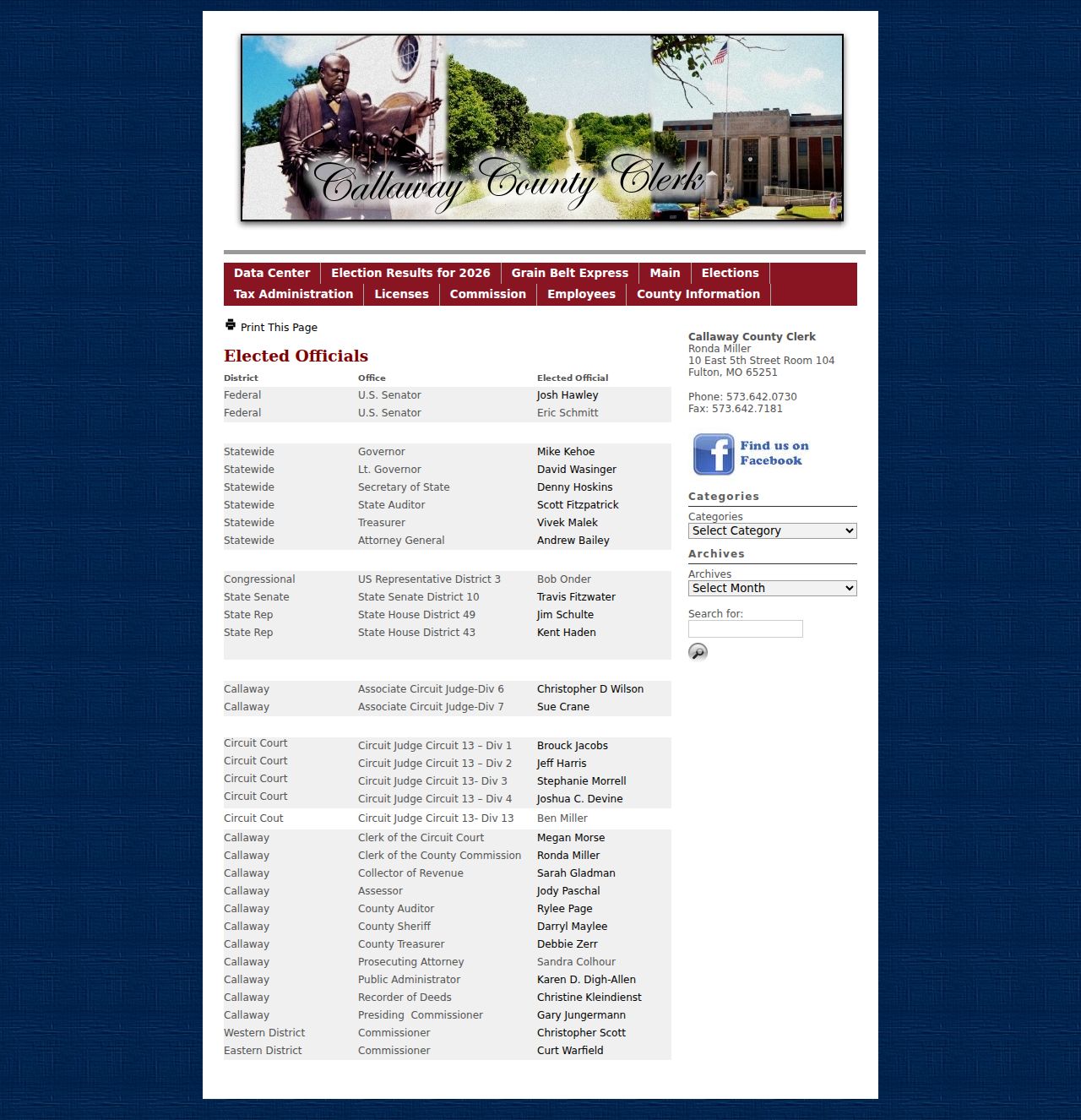
That separation is practical. It keeps a court docket request from landing at a county-government records office that cannot fill it.
Callaway County Civil Copy Requests
A docket printout, a filed document, and a certified copy are three different things. Case.net shows the public index and sometimes a linked document. A certified copy is a clerk-authenticated reproduction, and only the Circuit Clerk issues it. The official 13th Circuit civil and family copy forms ask for your contact information, the case number, a description, the document name or date, plain or certified format, delivery choice, and a cost estimate. A transcript is separate from a clerk printout too. Identify the hearing date, time, judge or division, and case number when ordering one.
The fee schedule adds up fast. The family copy form lists a first page at $1.00, additional pages at $0.10, certification at $1.00 per page, and seals at $1.00. Possible postage and clerk-time charges sit on top. Payment comes before processing, and the form allows 10 to 14 business days after payment. The court sets no separate Callaway-wide search, scan, or email fee. Confirm the actual charge with the Circuit Clerk before you pay. The 13th Circuit family copy request form documents those fields and fees. Its printed Boone County address is not the Callaway processing address. Verify the destination first.
The 13th Circuit civil copy request form covers plain and certified documents plus an audio or transcript section. Describe the record exactly. A precise description lets the clerk pull the right document. It beats guessing from a general case topic.
What Cases Fill the Civil Docket
Civil dockets in Callaway County hold several distinct court paths. Contract, debt, property, and injury cases fall under the circuit civil category. Small claims sit on the associate schedule. Probate and estates get their own calendar block. Dissolution, paternity, and family motions belong to family court, where public access can be tighter. Municipal ordinance cases may appear in the same statewide system. That does not make them ordinary civil matters.
- Circuit civil actions, including claims and disputes assigned to civil divisions.
- Associate civil matters and small claims settings.
- Probate and estate cases assigned to the probate calendar.
- Family matters, including dissolutions and paternity, subject to their access limits.
- Orders of protection and other listed case categories with their own procedural or confidentiality rules.
Callaway County civil cases show up across two different schedules. The 13th Circuit calendar covers Civil, Contested Matters, Trials and Motions, and Dissolutions. The associate calendar runs its own list. That list includes contested civil, civil returns, small claims, probate or estates, family matters, and special settings. When a schedule label seems vague, check Case.net. The case type and division listed there are the more reliable guide for any Callaway County court docket.
Callaway County Civil Return Blocks
The January 2025 associate schedule splits its civil time into two blocks. One is marked Civil Returns (NO CONTESTED). Another is marked ALL CONTESTED CIVIL. Knowing that split helps you read a Callaway civil docket correctly. A civil return is just a scheduled case event. It is not a judgment, and it does not prove the matter was ever tried. A contested block likewise marks a session for disputed cases. That marking is not a result in each one. For the truth about a single case, rely on the current Docket Entries. Also rely on any notice of setting.
Small claims, probate or estates, and family assignments get their own blocks too. Think of the schedule as the weekly pattern. Think of the case entry as the real date and status. A special setting sits outside the routine block by order of the court. Confirm it through the newest notice or order.
The Western District local rules belong to a separate federal court system. They never replace the Callaway Circuit Court's own civil docket rules.
State and federal docket channels stay separate. Keeping them straight sends a Callaway civil search to the right court system.
Hearings on the Civil Docket
On the civil docket, a setting might be a return, a motion, a trial, a hearing, or a special setting. The schedule gives local context. It can never substitute for the notice and the Docket Entries tab. A notice of setting is what puts a case on a date. Continuances complicate things. A reset can leave the old date sitting in the history. A later notice or order controls the current one. Court Operating Rule 4 requires calendar information in court recordkeeping. Security concerns and individual case activity can limit the public display.
If the schedule and the docket seem to disagree, write down the case number. Read the newest entry first. Then call the Circuit Clerk at 573-642-0780, or the court office listed on the notice. The Justice Center sits at 5 East 2nd Street in Fulton. Courtroom-door lists are sometimes posted on the day of court. Remember that the presiding judge can change assignments under the local rules. No recurring calendar pattern should be treated as the final notice for a case.
Callaway County Civil Judgment Fields
A public civil judgment entry can list the party, case number, judgment date, court, amount, satisfaction or vacatur date, and a summary, wherever the public index shows those fields. The civil docket may go further, with entries for execution, garnishment, post-judgment motions, appeal, and mandate. Some labels need translating. Satisfaction generally means the judgment was paid or met. Execution and garnishment are post-judgment collection events. Each label only names a step in the case; the precise effect always comes from the actual order or document.
- Default judgment
- A judgment entered when a party fails to respond or appear as required and the court authorizes default relief.
- Nonsuit
- A plaintiff’s voluntary end to a civil claim, usually before final judgment on the merits.
- DWOP
- Dismissed for want of prosecution, meaning the case was not actively advanced under the court’s practice.
- Mandate
- The appellate result returned to the trial court after review.
Note: A judgment entry can be public while the signed judgment or an exhibit behind it still requires a clerk request or a courthouse terminal.
Who Can See Civil Dockets
Case.net is where public access starts, but not every civil filing is public. Missouri Court Operating Rule 4 governs docket sheets and public access equipment. It also covers document security and confidential records. Rule 122 closes juvenile and many family materials. Protected personal information may be redacted or withheld entirely. Even a public case can hold a confidential filing-information sheet or exhibit. So a visible docket never guarantees access to every linked or unlinked document.
Callaway civil access points:
Use Case.net for the statewide public index and Docket Entries.
Use the courthouse public terminal when a public document is not remotely accessible.
Use the Callaway County Circuit Clerk counter, phone line, current copy form, or written request for a public file, docket sheet, or certified copy.
Missouri's Sunshine Law pushes government records open. A custodian must respond as soon as possible, generally no later than the third business day. Otherwise the custodian must explain a reasonable delay. The law still bends to court rules and statutes that close a record. If a public-record request gets denied, request the written grounds. Then ask the Circuit Clerk whether the file is public, restricted, sealed, or terminal-only.
The Callaway County Clerk contact page serves as a county-government contact. Court-file requests belong with the Circuit Clerk at the Justice Center.
The two offices hold different custodial roles. For a Callaway civil docket, the Circuit Clerk remains the proper route.
Callaway County Civil Docket Files Without PDFs
Sometimes a Docket Entry has no link. That means it either lacks an attachment or is closed to the current viewer. Before contacting the clerk, save the case number. Also save the entry date and the exact document description. The Circuit Clerk can then tell you whether the file is public. It may be confidential, sealed, or viewable at a public terminal. For older records, ask whether the material is at the Justice Center, in storage, or on an approved media system. Rule 4 allows paper, microfilm, microfiche, and electronic formats. It also permits court-supervised reconstruction when a file was lost or destroyed.
Federal civil and bankruptcy cases live outside Missouri Case.net. Callaway County falls inside the federal Western District of Missouri's Central Division. That system is searched through PACER and its own channels. A federal bankruptcy court source helps you see the boundary. It cannot replace a state civil-docket search.
The U.S. Bankruptcy Court for the Western District of Missouri handles the federal bankruptcy channel. It serves matters beyond the Callaway Circuit Court docket.
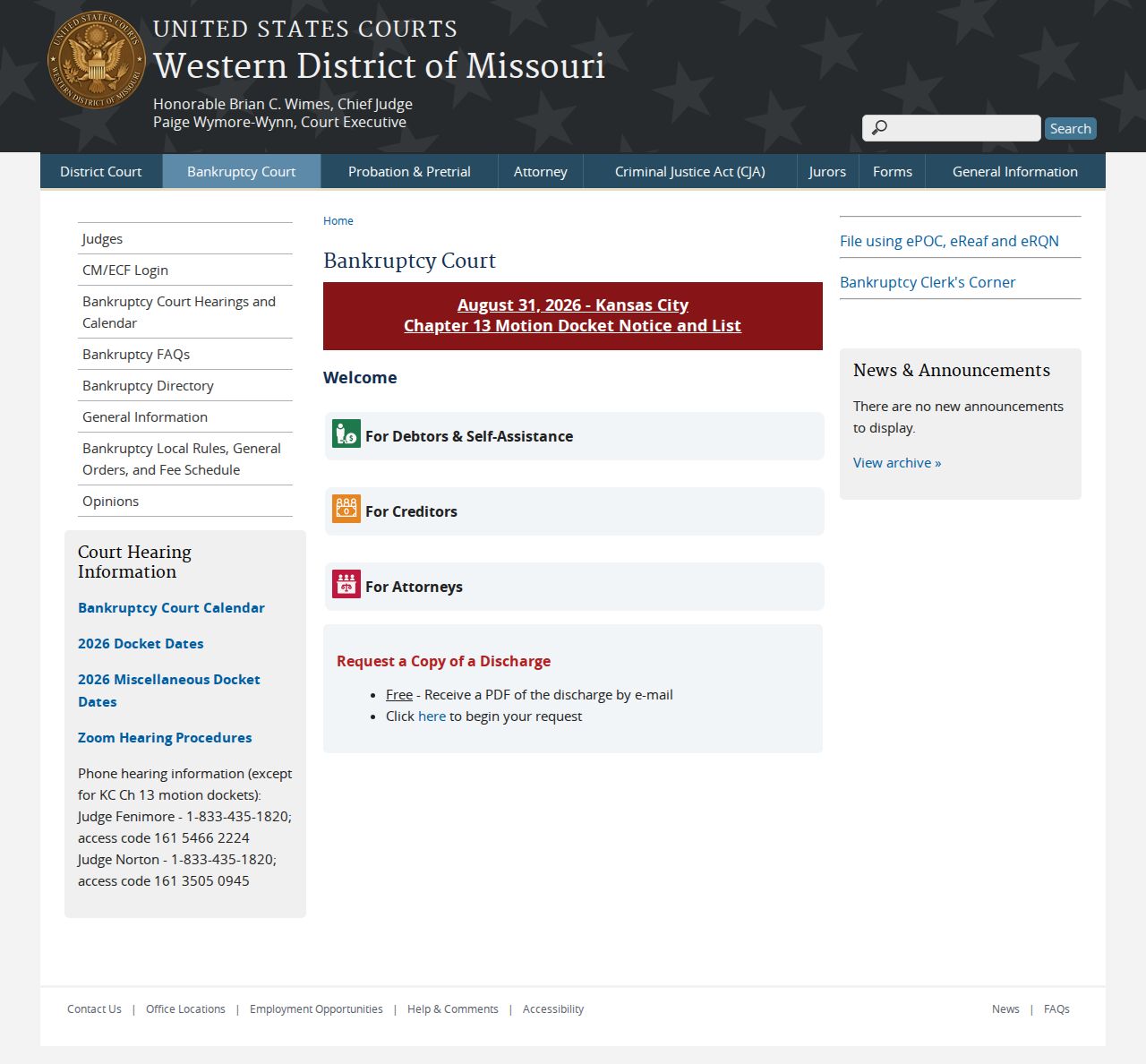
Callaway County civil docket records stay close to home. Unless a case belongs in federal court, look for it through Case.net or the Callaway Circuit Court Clerk.